


Modern Slavery : Legacy of Negligence and Servitude, Tea Workers in Bangladesh
- Subrata Shuvro
- Sep 1, 2022
- 14 min read
Updated: Oct 20, 2022
Until the fair demands of the tea workers are not met, if we drink tea, this responsibility will definitely fall on our shoulders as consumers. If the consumers do not say that all the tea brands of this country mixed with the sweat and tears of innocent workers can only improve the quality of life of the workers.

The women and children who work in tea gardens, they have no socio-economic security. The poor workers of the tea gardens are being deprived of various facilities year after year. The tea industry is dependent on the women of tea communities as nearly half of the tea workers are women. Most of these women are tea leaf pickers and others work in tea factories. Yet the women of the tea gardens face multidimensional discrimination and a unique set of problems which are often overlooked. Their needs and demands remain suppressed under the twofold oppression of the tea industry and the chains of patriarchy. Needless to say, the lives of the tea workers cannot be improved if the specific problems faced by the women are ignored.
How much wages do workers get?
In Bangladesh, tea production increased, growth has increased. But the life of the workers remained the same as the British era. In the British period, the wages of the tea workers were first 21 taka. In phases, Tk 28, 48, 69, 85 and Tk 102 respectively. And in 2015, it was set at Tk 120. The price of their daily labor, including ration, is Tk 158.20 . If you can work 8/10 hours a day, then you get Tk 120 wages. If you collect less than 20kg, wages are paid for less than 120 taka. Although 23 kilograms are meant to be collected, 24 wages are collected for wages. The extra kilos will cost up to three and a half paisa. How does a family of 4 people with this 120 taka touch the sky in this market price? Monthly salary of a worker is 3,600, which does not cost the cost of a worker.
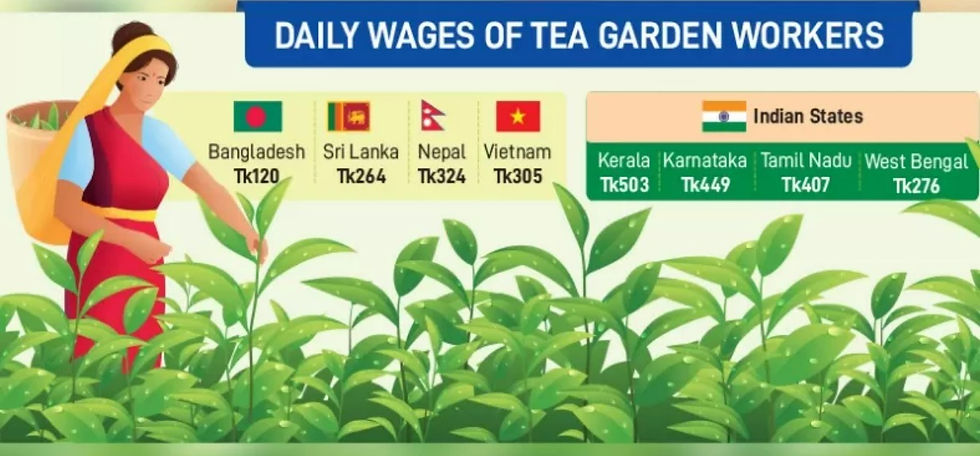
-Tea gardens are divided into three groups A, B and C. The maximum wage per day is Tk 120 in tea plantations of this category. The workers are now demanding 300 takas per day. Although their wages are supposed to be increased every two years, they have not been increased after 2018. In addition to wages, workers get three kilograms of flour a week, at the rate of two TK per kilogram. But it is not for everyone Those who have ration card get it But if they don't work, they are not given it if they are sick.
Because they did not have their wages in this wage, they collected timber in the garden for extra income, ducks, chickens and goats in the house. The workers of some garden produce paddy, vegetables-in the jungle cut of tea garden. Workers can buy the most inexpensive silverware fish in the market once in two weeks. They went to work in the morning with the dried chilli and made tea and gram flour. Khan dried bread at noon. And get a chance to eat only one-day rice every night. If you do not have money, you can not eat rice.
Besides, they are supposed to provide medical and housing facilities. At the same time children should have educational facilities. Meanwhile, as the wages are very low, all the tea workers are in debt. They take loans from various NGOs. Loan installments are to be repaid every week. As a result, they cannot take home their wages. And the children suffer from various diseases including malnutrition.
How do workers move?
-Chandan Kurmi, worker of Maulvi Bazar Baramchal tea garden. A family of six including his wife two children and two brothers. Everyone depends on him. He said, “Breakfast is made with the flour available in the ration. At least 2.5 kg of rice is required for lunch and dinner. I can't even buy two and a half kg of rice with my salary. Where can I get money for other expenses? In fact, even if we don't eat even one meal, the family does not survive."
There is also a gap in the workers' wages of Tk 120. He said, "If you pick at least 20 kg of tea leaves, you will be paid Tk 120." If it is less than 6 taka per kg is deducted. But if it is more than 20 kg then only two takas more per kg is given.”

If the workers cultivate crops or vegetables in the tea garden land then they are not given ration again. Treatment means nothing but paracetamol tablets are given from the health center for any disease.
Dayal Amlik, a worker at the Kaliti tea plantation in the same area, said, “We can eat fish and meat once or twice a year during a festival. And we continue with vegetables planted next to the house throughout the year. And I can't eat all the time."
At one point he said in a breathless voice, “Believe me we are not eating. We cannot educate our children. The NGO's school here does not teach beyond class five. Our house is leaking. Five tins give one. We are living inhumane lives.”
Workers have their own land, or live in the tea garden?
- Tea plantation workers have been living in the tea plantations for 150 to 200 years as their own land But still they have not got ownership of the land They still remain under the owner
Children have the opportunity to study?
- 50 percent children of tea workers get primary education while in other parts of the country about 99 percent children are enrolled in primary. This is much lower than the national average. By chance, there are 167 tea gardens in Bangladesh The number of government primary schools in those districts is very less Besides, there are some schools from the owners side But they are unsuitable for education There is no learning environment One teacher has three to four hundred students Education is going on in this condition Adequate number of schools is needed The sons and daughters of the laborers have to walk one to one and a half kilometers through the hilly roads to go to school As a result, many do not go to school The slave system of the British era is still going on in tea gardens
The government has several programs to help poor people. But these programs are not enough for them. Tea workers are lagging behind in almost all indicators including education, health, social security. Only 15 percent of workers receive health care. According to the Labor Act, pregnant tea workers are entitled to 16 weeks of leave and other benefits. But factors such as limited access to antenatal and postnatal services, malnutrition and inadequate health care contribute to pregnancy complications and maternal mortality among women tea workers. And there is really nothing to say about treatment
A worker said, "One kilogram of wholesale leaves is sold by the owner for 300 taka." Give us six takas We grow gold, but we do not get its fruits. Our children cannot study. We are not treated. We do not have tin in our house. All these should be given to them A kg of tea is sold for Tk 500 in the retail market, the laborer gets Tk 6.
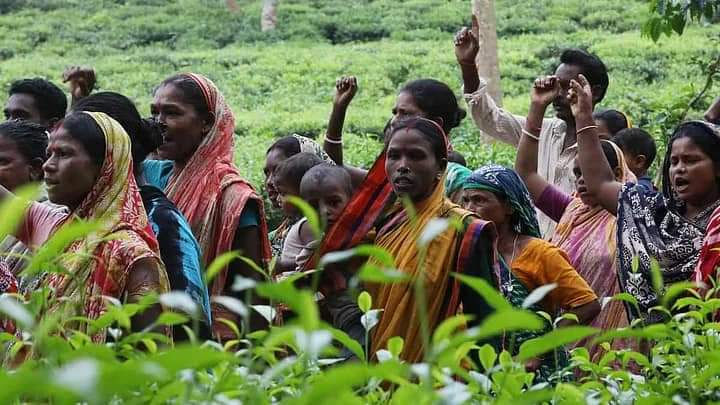
Being forced into a life of slavery-
"They have been cheated by increasing the wages of only Tk. 25. The 300 Taka wage they demanded is also much less than the current market rate They are being forced into a life of slavery The price of one kg of rice is 70 taka Then how will they survive The flour that is given in the ration is also small. The price of one kg of tea is 500 taka in the market They pick at least 20 kg of tea leaves a day They are not given the price of a kg of tea We want the Rs 300 demanded by them to be given.
Wages or Rations: Discrimination does not end there
Many say that the tea workers get many other benefits that make up for the low wages. So what are the benefits? First comes accommodation, electricity, water, sanitation, ration, education, bonus etc. If we go a little deeper, it can be seen that all these are some kind of misconceptions.
Wages are subject to conditions at the rate of Tk 120 per day. If you pick 23 kg of leaves in a day, you will get 120 taka wages, if you pick 1 kg more, you will get 4 taka 25 paisa more, and if you pick one kg less, you will get 5 taka 20 paisa. Now let's come to the ration. In terms of ration, if the husband of the family works, he will get 3 kg 200 grams of flour or rice, in that case the wife will get 2 kg 800 grams, two children under 12 years will get 2 kg 400 grams of ration. But husband will not get ration if work is done in wife's name. And there is no ration for children above 12 years. So what's up? In the family where the wife is working and there is no small child, they are basically getting ration of 3 kg 200 grams. They may have elderly parents and more children, who are largely dependent on that 3kg 200g ration. A child whose mother used to buy only one egg in 2007 (because she could not afford to buy a chicken) can now buy an egg from Tk 120 to Tk 15?
At present, the condition of workers in tea plantations is not very good They are suffering a lot Tea workers have many problems in their homes In what we call 'Labour Line', 8 cubits by 12 cubits each is a tea worker's house. They live with 8 to 10 family members in that house, one in one kitchen. In the meantime, a family of seven to eight members are clinging to this. The garden authorities are not allowed to make houses separately outside the houses given by a labor garden authority. If anyone took the initiative to build a house, then the worker was threatened with getting out of service. But for the workers of the workers under the 32-part government labor law, it has been said that one worker will be evicted within one month after his retirement. Electricity facilities are not available but the houses given to the garden owners have electricity connections. But at the end of the month, the authorities cut off the electricity bill from the workers' salary. Taking Tk 15 a year for poultry and poultry There is also a 12-year tax for the clay oven in the house of the workers. And in the cows and goats, they were fined 100/500 taka.
When a son of a tea garden worker is ready to work, he will join his father's garden as a worker - this is the rule. Even if she does not want to marry his son, his wife will also be required to enter the work of the garden as compulsory. Workers working in tea gardens are suffering from diseases such as malnutrition, diarrhea, dermatitis and pregnancy problems. These women workers or male workers are also in dire health risk. Especially women workers are working at the risk of not going on holidays for the wages of maternity wages. Both the mother and the pregnant woman are suffering due to their eight hours of standing in the womb during the pregnancy period. Women usually collect leaves in tea gardens, make pots of nurseries and collect seedlings etc. Often they have abortion to work in tea gardens. Because these workers do not take leave until the baby is born since pregnancy. Maternity leave is not on their forehead. So the child was able to stand in the sun for eight hours with a stomach. A mother does not share the amount of rest and balanced diet that needs to be eaten at this time. The child who is born of malnutrition, who is born of child labor, is born with many complications. The children have physical and emotional pain due to working on their stomach. Many types of physical complications also occur. But there is no way to suffer their sufferings. When working in the garden, the workers also do mistreatment while drinking water or eating betel. There is no adequate tubewell or pure water system. There is no necessary sanitation system in tea garden; The situation is bad too. As a result, the workers and their family members are often infected with diarrhea. Again, if there is a major disease, the owners will spend half the cost. Stomach aches, headache, chest pain give paracetamol to the same medicine.
Why is movement lost?
Many may think, what are the leaders of tea workers? What is their union doing? The culture of selecting any representative, bringing him to town functions, giving him various facilities and slowly getting him to a place where he can exploit others of his own group has been going on in the tea gardens for years. This is normal practice to put any logical movement and claim on the way. When I first met Pradip Naidu in 2007, the daily wage of a tea worker was Tk 27. Today in 2022 that wage is 120 taka. In these fifteen years, the tea workers have been able to increase the wages only by 93 takas, while the daily per capita income of the people of Bangladesh is around 812 takas.
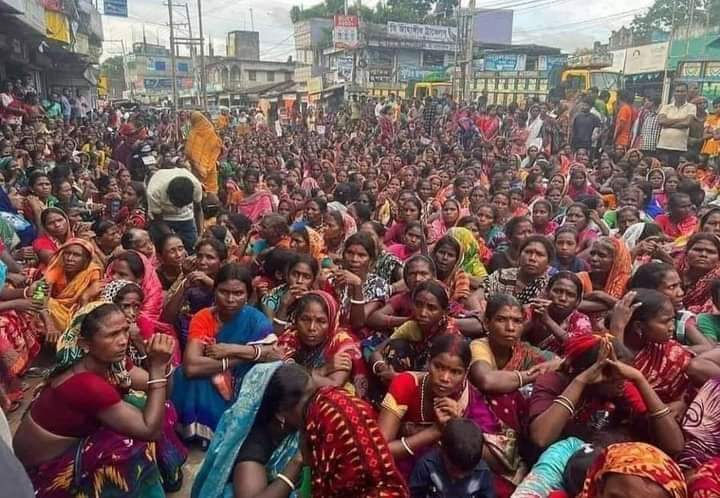
For quite some time, the tea garden workers have started strike and strike demanding a wage of 300 taka. The unionized workers have gone on strike many times before, their union leaders came to Dhaka to negotiate. With that, the fair movement of the tea workers was sold.

The World Federation of Trade Unions has made a statement in solidarity with the movement of increasing the wages of tea workers in Bangladesh.
Disinformation about wage-ration of tea workers by Garden owners and ‘Bangladesh Tea Association’:
When the tea workers are agitating for a daily wage of 300 taka, the owners are saying that they pay the tea workers 402 wages. Several media outlets have published reports with this information, which are clearly untrue and a ploy to mislead people. The real truth or reality about the wages and rations of tea workers is explained here.
1. The owners say that they pay Tk 76.92 for daily house rent, Tk 7.50 for medical treatment, Tk 0.02 for land development tax, and Tk 14 for home grown fruits, which is Tk 98.44. In reality it is a scam.
Section 2(45) of the Labor Act clearly states that money paid by the employer towards accommodation, light, water, medical facilities, retirement allowance or provident fund shall not be included in wages. For this reason, the money that the owners are showing to be paying for wages in the above sectors, has no legal basis. Again there is a clear instruction in the Labor Act, the owners shall ensure the housing facilities of the tea workers (Section No. 96).
It should be remembered here that tea industry is not like other industries which can bring workers from outside. Due to the special nature of the tea industry, the workers have to stay in the plantation. And this garden is being cultivated by tea workers from generation to generation. The owner has changed, but the workers are still there. For this reason, what can be more than a ludicrous argument to show the price of home-grown, jackfruit or guava fruits to the wages of the tea workers?
2. Owners show, packing bonus, 65 Taka per day for more work in field or factory. It is not actually a normal daily wage. It is the overtime money of workers. Section 108(1) of the Labor Act provides for the payment of twice the normal rate of wages for overwork. Therefore, showing them in daily wages means cheating the workers.
3. Owners say a worker is given 10.615 kg of rice or flour a week. The price of which is 30.79 taka. But the reality is that a male worker is given 3.270 kg ration, his pet is given 2.44 kg to a female worker, 1.22 kg to a child (if there is a child). These together are 6.93 kg. Women do not receive rations for pets. Ration is deducted if absent from work for any reason. Those who receive ration in other sectors are not shown as wages. As policemen get ration, it is not treated as wages or salary.
4. Two festival allowances are given in a year and annual festival allowance based on work attendance. The owners are adding this allowance to the daily wages (4.60 + 15.45 taka), which is unfair in reality. Because, the Labor Rules framed under the Labor Act state that each festival allowance shall not exceed the monthly wages and shall not be considered as additional wages.
So why is the owner adding this money to the wages?
And if we assume that the tea workers get a daily wage of Tk 403, then according to the law the festival bonus will be (30*403=12090*2=24180) Tk. Does it pay the owners?
5. The owners say that the tea workers are paid Tk 4.60 per day for the leave (14 days) earned every year. This is also deceptive. According to the Labor Act, tea workers get 1 day of paid leave in every 22 days (Section 1(b) of 117). These days wages are the legal right of the workers. Even if the worker does not take leave, he can claim wages for those days against it. Linking these amounts to daily wages is a fraud.
Thus, every argument raised by the owners can be refuted. But that much seems to clear things up. So, let's be vocal for the fair rights of the tea workers. Conscious and conscientious people of all levels of the society should stand by the tea workers in realizing this demand.
170 after 19 days of protest demanding 300 taka. This problem will rise again if the wages in this sector are fixed through the wage board in accordance with the labor law Wages are fix here. Till now 170 Tk (1.80 USD) is not acceptable. 170 Tk low wages will not cover the food of the whole family, not even a bit of nutritious food for themselves.
Today the tea workers have come to work in the gardens in full force. No one wants to know if they are really happy? In all the gardens I visited yesterday, the tea workers were not happy anywhere. not one And at Chunarughat where the joyous procession took place, the 'live show'; I have seen and learned how the people of the government party and the administration have done that 'joy festival' by adopting some tactics including intimidation. To what extent have the expressions of anger of the tea workers who reacted angrily reflected in the media? The movement of the tea workers of this country, imprisoned in the slavery of life after life, has been brought to an end in a planned way.
'God lives in that village, in the gentle countryside - he cannot be found here.' This line from Manik Banerjee's Padma River Majhi is in no way out of mind. For the past 170 years, countless Kuber, Mala and Kapila spend their daily lives in slavery, poverty and sorrow in the tea gardens.
Meanwhile, it is important to question the role of mass media. Nowhere did the news publish with any importance of editorial, opinion.
When the tea plantation started 168 years ago, the wage was 1 sika (1 pence, there are 100 pence (p) to the pound (£)), it was British rule. They used to swing the stick over their heads. And some 'Babu' class people who were their footmen used to do the work of catching the hips or playing the tabla. The country was divided two times. The slavery of tea workers did not end, but increased. What is the explanation? The explanation is that the ruler has changed, the rule has not changed. Year 2022, times have changed. After the 19-day agitation of tea workers, wage determination of 170 Tk. It cannot be allowed to 'win' in the movement by accepting fair demands, it cannot be allowed to increase 'self-confidence'. That means the feudal character of the ruler has not changed. "Babu" was not lost either. Their blood is still coursing through some arteries. They have divided the society into two political hues—ruling and opposition. As before, the 'Babus' are ruling priests and the 'Dalit slaves' of this age are the tea workers.
A Documentary On Tea Worker || Lifestyle Of Tea Worker In Bangladesh:
Tea Labours Salary difference in India & Bangladesh:
More news about Tea-Workers:
* Tea workers strike for wage hike in Sylhet : https://en.prothomalo.com/bangladesh/local-news/rh0gtln0ih * Tea workers union calls countrywide strike sine die from Saturday: https://en.prothomalo.com/bangladesh/gwhj6o5au8
* Tea workers strike against dollar-a-day wages : https://en.prothomalo.com/bangladesh/bangladesh-in-world-media/1pxlmyvcpb * Tea workers reject Tk 25 wage hike, vow to continue movement : https://en.prothomalo.com/bangladesh/local-news/e9ep6qxv0u
* https://businesspostbd.com/front/2022-08-23/bangladesh-pays-lowest-wages-among-neighbours-2022-08-23
* https://en.prothomalo.com/bangladesh/local-news/fy6p7aw1j9 * https://en.prothomalo.com/bangladesh/xfyfldtbw1 * https://en.prothomalo.com/bangladesh/i3fh27yhd8 * https://www.aljazeera.com/news/2022/8/21/why-are-bangladesh-tea-workers-protesting * https://www.justnewsbd.com/en/national/news/17521 * https://archive.dhakatribune.com/bangladesh/2021/08/25/survey-74-tea-garden-workers-still-living-in-poverty
* https://www.thedailystar.net/news/bangladesh/news/pay-hike-demand-tea-workers-go-strike-3094256
* Our alliance tea-workers in movement: https://www.thedailystar.net/news/bangladesh/news/tea-workers-defiant-3101636
* https://www.daily-sun.com/post/641211/Tea-garden:-Union-leaders-lose-influence-on-workers
* https://www.thedailystar.net/news/bangladesh/news/unhappy-tea-workers-return-work-3105066
* Unhappy tea workers return to work: https://www.thedailystar.net/news/bangladesh/news/unhappy-tea-workers-return-work-3105066?amp
* News Footage: https://www.youtube.com/watch?v=GY8-93I1wAs&t=8s
* Research Paper: https://www.academia.edu/10584787/Life_in_the_Labour_Lines_Situation_of_Tea_Workers_in_Bangladesh


Comments